

For much of the last two decades, a large share of the value buyout funds handed back came from rising entry-to-exit multiples and from cheap leverage, not from making the businesses underneath run better, a point Bain & Company and a run of academic studies of the asset class have made for years. That was a workable arrangement while multiples climbed and debt stayed cheap. Neither holds now. Bain’s Global Private Equity Report 2026 puts the new reality bluntly: the industry will rely on a firm’s ability to rapidly generate strong EBITDA growth at its portfolio companies, “full stop.” Gain.pro’s Private Equity Value Creation Report 2025, drawn from more than 10,000 investments, finds revenue growth to be the largest single driver of value creation at 54%, well ahead of the 32% that comes from multiple expansion. The phrase “value creation strategy” has quietly changed meaning to match: it used to describe a slide, and now it has to describe a capability a fund can actually operate.
Value creation is several levers, not one word
Part of the confusion in any value-creation conversation is that the term covers a handful of genuinely different disciplines, each with its own owner and its own clock, and people use one word for all of them. Our pillar on value creation in private equity sets out why the operational lever is the one that now matters most, given that the two that used to carry the return have gone quiet. This piece sits underneath that argument and does a narrower job: it lays the full set of levers out plainly, shows how each one is pulled and by whom, and explains why the lever most plans still underweight is also the most defensible at exit.
Start with the buyout return itself, because the levers are easier to separate once the return is. A return decomposes into three broad sources. There is multiple expansion, buying at one valuation and exiting at a higher one. There is leverage and financial engineering, using debt to amplify the equity and tuning the capital structure. And there is operational improvement, growing the earnings of the business through revenue and margin. For a long stretch the first two did most of the work, and a fund could hit target with the third barely moving.
Why the easy strategies stopped working
The environment that made those first two levers reliable has changed in ways unlikely to reverse on a normal hold. Entry multiples across most of the mid-market are no longer dependably rising, so the exit can no longer be underwritten on a free turn of valuation being there to collect. Debt costs more than it did through the 2010s, which takes the amplifier off financial engineering as a primary driver. The funds have already repriced their own attention accordingly: KPMG’s work on value creation in private equity now frames the winning capability as “operational alpha,” the discipline of generating returns from how portfolio companies actually run rather than from the deal structure around them. McKinsey’s Global Private Markets Review points the same way the Bain decomposition does: the funds pulling clear of the pack are the ones that treat operational improvement as an institutional capability rather than a line they hope the management team delivers.
What is left, when the two easy levers go quiet, is the one that always needed real work to move. Operational improvement is the lever a fund can still pull with its own hands regardless of what the rate environment does. It is also the one that survives scrutiny at exit, for reasons the EBITDA bridge makes plain later in this piece. A value-creation strategy built for the current market is really a plan for pulling this lever deliberately instead of hoping it moves on its own.
What are the levers of value creation in private equity?
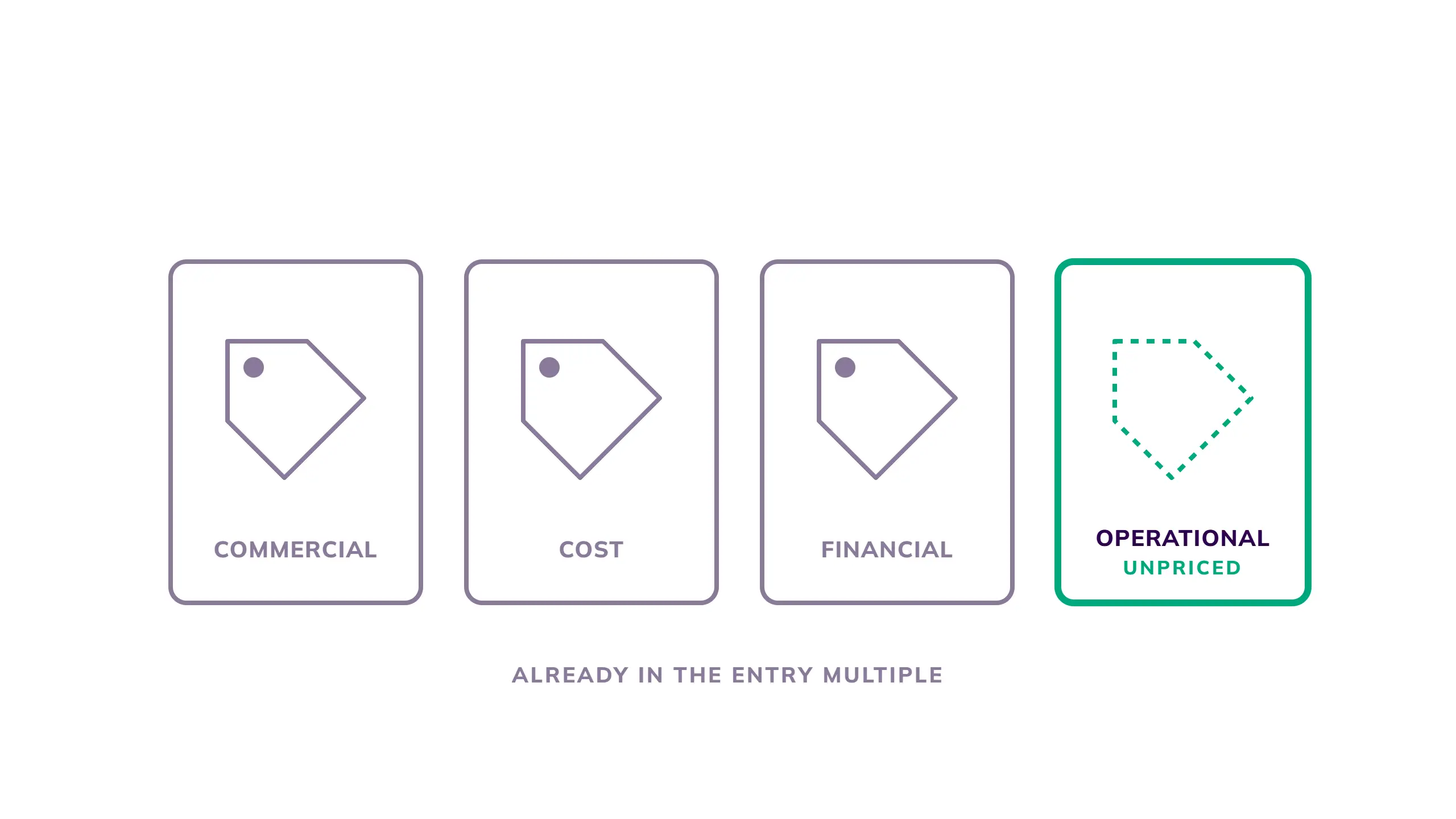
“Operational improvement” is itself too broad a heading, so it helps to split value creation into four working levers. Each has a different owner, a different time horizon, and a different degree of visibility at the point you underwrite the deal, and it is worth setting them side by side before going deeper on the one that matters most.
| Lever | Who owns it | Typical payback | Visible at underwriting | Where it stands now |
|---|---|---|---|---|
| Commercial | Commercial or revenue lead | Can show in-year | Partly, a pricing change models cleanly | Often the first move a plan reaches for |
| Cost | Operations and procurement | Medium | Yes, relatively easy to model | Mostly priced into the entry multiple by rival bidders |
| Financial | Deal team and CFO | Fastest of the four | Yes | Thinned out by the higher cost of debt |
| Operational-process | Needs a single accountable owner, often missing | First year and continuing | No, the hardest to model | Largely unpriced, and the most defensible at exit |
The first three are the levers every value-creation deck already knows how to pull, and the entry multiple usually assumes them. The fourth is how the business actually does its work day to day, across its processes, its systems, and the manual effort sitting in the gaps between them. That is the lever most plans underweight, because it is the hardest to write down as a clean number when you are underwriting, and it is the one this piece keeps returning to.
The lever most plans underweight
The operational-process lever is underweighted for an honest reason, not a lazy one. A pricing increase or a refinancing is easy to put in a model at entry. It is much harder to quantify what a portfolio company is losing because its people spend their days moving data by hand between systems that were never connected to each other, and harder still to commit to recovering a set figure of it on a schedule the investment committee will hold you to.
At Digital Forms we name the pattern underneath this lever the Manual Wall: the growth ceiling a company hits when it keeps adding headcount to absorb volume that software should be carrying. In a portfolio company it usually hides in plain sight, because the business is growing and the growth looks healthy, while underneath the payroll line is climbing faster than throughput and every new hire is quietly brought on to do work a connected system would have removed. The recoverable value is the gap between that trajectory and one where the same volume is carried by workflow instead of by hiring, and it is large precisely because nobody has been measuring it. We go further into how an operating partner sizes this specific lever, and how to tell a real one from an expensive distraction, in our piece on what operating partners miss in portfolio operations.
The reason this lever rewards the work is the same reason it is hard to model. The levers that are easy to put in a spreadsheet are the levers every other bidder has already competed away in the price. The operational-process lever is still available in most mid-market portfolio companies because it has never been on anyone’s plan, which makes it the one place a fund can create value the entry multiple did not already assume.
How do operating partners sequence the levers?
Having four levers does not mean pulling all four at once, and a value-creation plan that tries usually delivers none of them well. The sequencing question matters more than the inventory of options, and the right order is not the order of theoretical prize size.
The discipline we use, and the one we build our engagements around at Digital Forms, is ROI-ordered sequencing: we order the initiatives by where the recoverable cost actually concentrates and how fast a result can be proven, biggest defensible number first. That ordering does two things a prize-size ordering does not. It puts an early, visible win on the board that pays for what comes after it rather than competing with the operating budget for funding, and it forces the plan to rest on measured cost rather than on the most optimistic line in the model. A plan that opens with a nine-month platform programme before it recovers a single dollar tends to lose the room long before the payback arrives.
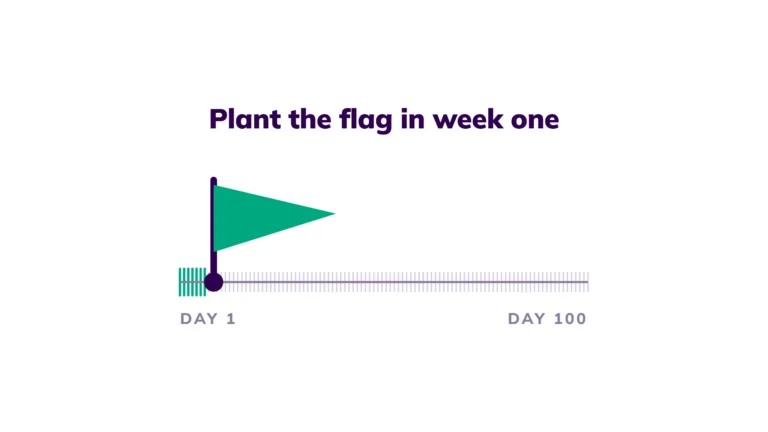
Timing across the hold matters as much as order. The strongest operational reads start in diligence, not at close, because the upside operations can release is also the upside standard diligence almost never quantifies. Commercial and financial diligence are thorough by default, while the operational read comes back as a risk report that gets filed rather than a value model that feeds the price. Treating technology and operations as a value question before the deal closes, which is the argument we make in full in our piece on the technology blind spot in operational due diligence, is what gives the value-creation plan a real chapter in the 100-day plan instead of a discovery phase that eats the first two quarters of the hold.
How is each lever measured at exit?
When a deal is realised, the return gets attributed back to the levers that produced it, usually through an EBITDA bridge that walks from entry equity value to exit equity value. The bridge separates how much of the gain came from revenue growth, how much from margin improvement, how much from movement in the multiple, and how much from paying down debt. It is the scorecard that tells the fund and its investors where the money actually came from, as opposed to where the plan said it would.
The bridge is unforgiving in a way the underwriting model never is. It shows multiple expansion for what it was, a market movement the fund did not create, and it isolates the operational contribution as the part the fund can genuinely claim. A hold that leaned on a rising multiple reads very differently at exit from one that grew earnings, even when the headline return is close, and increasingly it is the second kind that raises the next fund. That is why the operational-process lever is not only the hardest to model at entry but also the most valuable at exit: it is the component of the bridge that stands up to scrutiny and that a limited partner will pay to watch a manager repeat.
Why value-creation strategies stall at the portfolio company
A value-creation plan can be right about every lever and still fail, and the place it fails is rarely the fund. It is the portfolio company. The mandate arrives from the operating partner, the CEO agrees with it in principle, and then it competes for attention with the daily work of running the business and slowly loses. The missing piece is usually ownership: a single person accountable for turning the plan into delivered operational change, who is not also trying to keep operations running at the same time. This is the CDO gap in a portfolio-company setting, the missing seat between the operating partner’s mandate and the people running the business day to day, which we describe in detail in our work on why AI and transformation mandates stall at the portfolio company. It is a matter of design rather than a failure of will.
This is where the shape of the engagement counts for more than the quality of the analysis. A plan handed over as a document depends on the portfolio company having spare capacity and specialist expertise it usually does not have. A plan carried by an embedded team that stays to deliver it does not carry that dependency, and the difference between the two is the difference between a strategy that moves the bridge and one that gets read back at the next board meeting as something that was meant to happen.
What this looks like without a logo attached
Picture a mid-market services business inside a portfolio, growing revenue at a healthy clip, margins holding steady on the quarterly pack. The operating partner is confident there is upside in operations but cannot size it, because it does not appear as a line anywhere. Underneath, a large share of the workforce spends the day on repetitive, rules-based work moving information between systems, and the company has been meeting rising volume by hiring rather than automating, because hiring is the path of least resistance and its cost is buried inside a headline number that reads as success.
The lever becomes real the moment someone counts the hours going into the repetitive share of that work and prices what recovering them is worth. In operations at this scale the recoverable figure is routinely large enough to move the margin line by a meaningful amount inside the first year of a hold. No heroic transformation is required to get it; the work simply was never automated in the first place. That is the operational-process lever in concrete terms, and it is sitting unpriced in most mid-market portfolio companies for the simple reason that it has never been on the plan.
What an operating partner can do with it
The first move is measurement, not a technology decision. Before committing to any build, a fund needs to know where a portfolio company’s handling cost and operational drag actually concentrate, which is what we built our Profit Leak Diagnostic to surface, because operators consistently underestimate how much margin is trapped in processes they have long stopped noticing. The output is a ranked list of where the recoverable cost sits, and that list is the raw material of a credible value-creation plan rather than an aspirational one.
From there the discipline is to build narrow and prove it fast, so the first result funds the next instead of arriving as a budget request that competes with everything else on the operating partner’s desk. The move we usually make first is an Operations Sprint that automates a single high-value process and puts a working result live within weeks, and across a whole deal the same discipline runs from diligence through the hold to the exit, which is the engagement we set out on our private equity page.
The uncomfortable part of the new math
For a generation of investors the skill that mattered most was buying and structuring well, and the operational story was left for the management team to write. That order has reversed. The funds that will struggle are not the ones with the wrong theses about which lever to pull, but the ones built to underwrite operational value creation they have no mechanism to deliver. The question worth asking about any asset a fund owns is not whether the operational lever exists, because at mid-market scale it almost always does, but whether the fund can convert it into EBITDA before the hold runs out.