
By the time the deal closes, the value creation plan already exists. It sits in the data-room appendix as a returns bridge with initiatives mapped against it, and within two quarters most of that operational detail has become a document nobody reopens. PitchBook put the median US buyout hold period at 5.9 years in 2024, just off the prior year’s record of seven, which means the plan now has to carry the return over a longer hold than the pre-2021 norm, on operations that were never built to deliver it.
That gap between the plan and the operation is where the return leaks. The commercial half of a value creation plan is usually strong, because it is the half the deal team knows best: pricing, the buy-and-build sequence, the sales-motion changes that show up cleanly in a model. The operational half, the part that assumes the portfolio company can actually process the higher volume the thesis depends on, tends to be written as an outcome (“reduce cost-to-serve by 300 basis points”) rather than as the workflow change that would produce it. The outcome goes into the bridge. The workflow change goes unspecified, and the people expected to deliver it are already at capacity.
At Digital Forms we see this from the operating side, and the shape is consistent across portfolios. A mid-market company that grew to its current size on the effort of its people hits a structural ceiling we call the Manual Wall: the point where the next increment of growth needs a disproportionate increment of headcount, because the work moving through the business is still stitched together by hand. A value creation plan that assumes the company will simply do more with the same team, without naming that wall, is planning for a company that does not exist yet.
Why this matters more than it did two cycles ago
When entry multiples were rising, a plan could miss on operations and the exit multiple would still cover it, but that cover is now gone. With multiple expansion no longer a reliable contributor, a larger share of the return has to come from the operating line, and McKinsey has put operational improvement at roughly 47% of buyout value creation since 2010, up from about 18% in the 1980s, well ahead of debt paydown or multiple movement. The operating half of the plan has stopped being the supporting act and is now where most of the return is either made or lost.
The cost of a plan that does not execute shows up in hard places: a returns bridge that misses in year two, a management team that spends the hold firefighting instead of building, and an exit conversation where the operational improvements were promised but never showed up in the numbers a buyer diligences. The plan looked complete at close, but the problem surfaced eighteen months later, when the initiatives that needed real workflow change had not moved, because nobody had specified how they would.
What is a private equity value creation plan?
A private equity value creation plan is the operating partner’s blueprint for converting the investment thesis into EBITDA growth across the hold, usually front-loaded by a 100-day plan that sets the first moves before the operating rhythm hardens. It spans the commercial thesis, the operational improvements, the organisational changes, and the capital and M&A agenda, and it ties each initiative to a number in the returns bridge so the fund can track the value being built against the value that was underwritten.
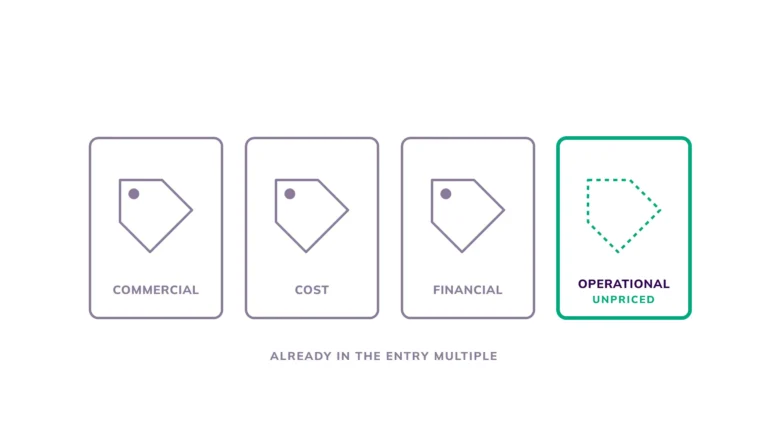
Most plans are comprehensive on paper. Where they thin out is the operational section, which often reads as a list of targets with no mechanism attached. “Automate the back office” is a target, not a plan, because it does not say which process moves first or what it costs today in fully loaded headcount. The levers that actually drive operational value are known and well documented; the gap is almost never knowing what to do, and almost always sequencing and execution inside a company that is already running flat out.
Why the 100-day plan usually stalls after the first quarter
The 100-day plan is written when energy and attention are highest, in the weeks around close, by the people who ran diligence. Then it is handed to a management team that was not in the room when it was built, and asked to deliver it on top of running the business, and that handoff is where the plan breaks down. A plan that specifies outcomes but not the operating changes behind them gives management no purchase, so the commercial initiatives that map to things management already does get traction, and the operational ones that require new workflow quietly slip.
This is the same blind spot that operational due diligence tends to underprice before the deal even closes. Diligence confirms the numbers and the market; it rarely maps how work actually moves through the business, so the operating risk that shows up post-close was invisible pre-close. The plan inherits that gap. It assumes a level of operational readiness that no one verified, and the 100 days run out while management is still trying to work out who owns the change and where the capacity for it comes from. What operating partners consistently find inside portfolio operations is not a shortage of good initiatives but a shortage of anyone with the time and mandate to carry them.
What belongs in the operational half of the plan
Start with measurement, not initiatives. Before a single improvement is sequenced, the plan needs a fully loaded cost on the manual work: how many people spend how much of their week moving data between systems, re-keying the same fields, generating routine documents, chasing status. That number is almost always larger than the deal model assumed, and it is the number that tells you which initiative pays first.
Then sequence by recoverable cost. It is why we sequence every initiative in ROI order, biggest recoverable cost first, rather than by whichever change is technically tidiest or easiest to socialise: the first move should retire the most expensive manual work in the business, so the saving funds the next move and management sees a result inside the quarter rather than at the end of the hold. A value creation plan built this way reads differently from the standard version. Each operational line names the process, its current cost, the change, and the expected recovery, in that order, so the initiative can be tracked the way a commercial one is.
A single line in a well-built operational plan looks concrete enough to argue with. Take an order-processing desk in a mid-market distributor, where a team spends most of its week copying order details out of emailed purchase orders into an ERP system and reconciling the two by hand. The current cost is the fully loaded time of the people doing it, which in a business of that size can run to several roles’ worth of payroll once the checking and the rework are counted. The change is to capture the purchase-order data once and pass it into the ERP without the re-keying, and the recovery is the payroll and error cost that comes back when the manual step is gone. Written that way, the line can be tracked against the returns bridge exactly as a pricing initiative is, and the operating partner can see in a board pack whether it actually moved or just stayed amber.
The plan also has to name what it is not doing. A portfolio company cannot run twenty operational workstreams at once, and a plan that lists twenty is really a plan with no priorities. Naming the two or three processes that move in the first hundred days, and explicitly parking the rest for later phases, is what makes the difference between a plan that gets executed and a plan that gets admired.
Who carries the plan through the hold
Here is the question the plan usually leaves unanswered: who, specifically, owns the operational half day to day. The operating partner cannot embed for a year. The management team is at capacity, which is the whole reason the company hit its ceiling. Hiring a full-time transformation lead into a mid-market portfolio company is often too heavy for the size of the business and too slow for the length of the hold. So accountability for the operational plan diffuses, and diffuse accountability is how a workstream becomes a line in a board deck that stays amber for four quarters.
The people already doing the work cannot carry it either, because they are the ones acting as the Human API: the highly paid connective tissue holding together systems that were never integrated, whose entire day is consumed keeping the current volume moving. Ask them to also redesign the workflow and you get neither. This is the case for a single owner of the operational outcome who is neither the operating partner nor a permanent hire, which is what we built External CDO as a Service to be: one accountable owner who carries the operational half of the value creation plan across the portfolio company for as long as the hold needs, and no longer.
Sequencing the first 100 days
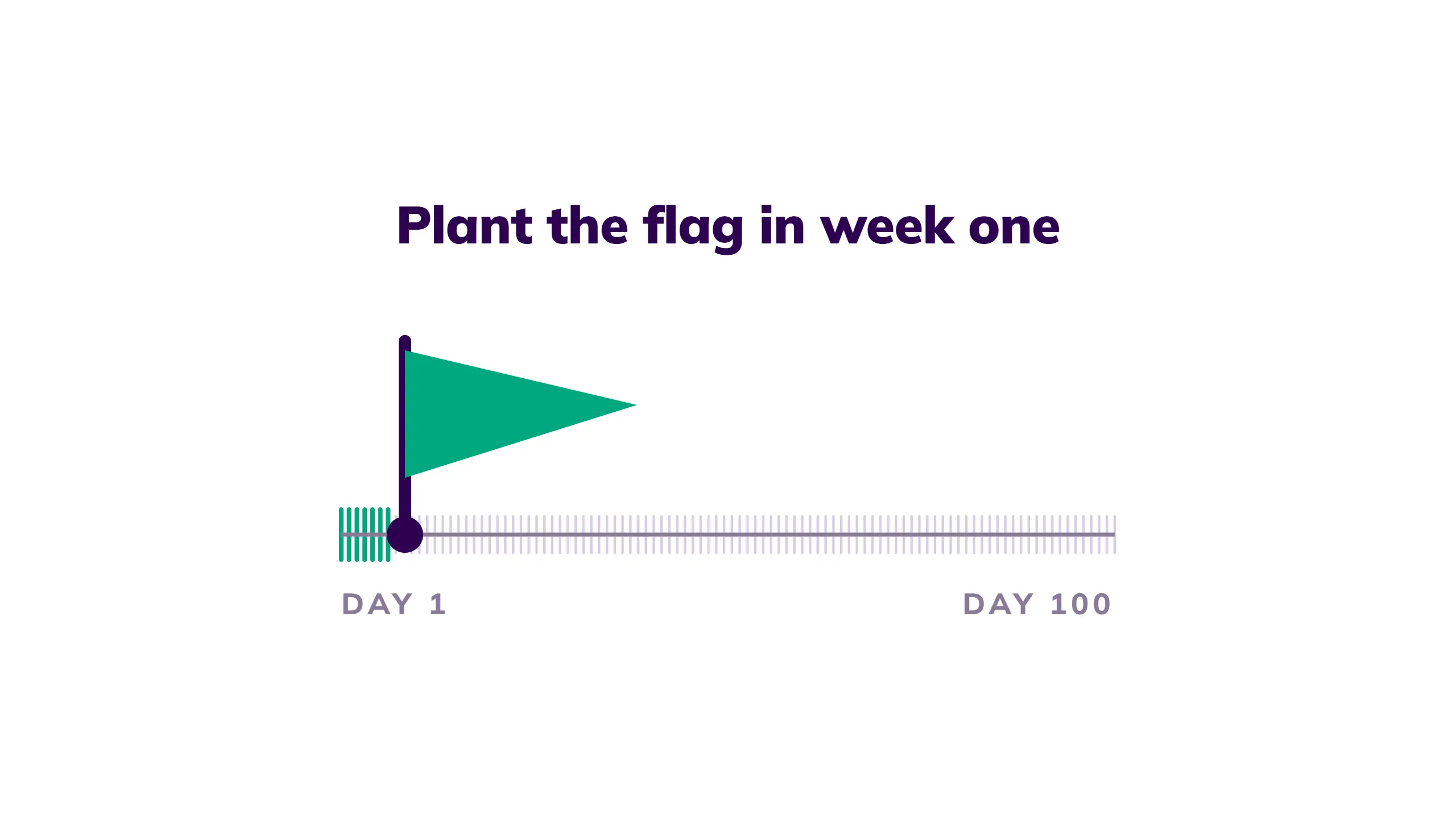
The first hundred days should buy information and one visible result, not a finished transformation. In our engagements the opening move is a diagnostic that puts a fully loaded cost on the manual work and ranks the processes by recoverable spend, which is what our Profit Leak Diagnostic is built to produce inside roughly four weeks. That gives the operating partner a costed, sequenced operational plan grounded in what the business actually does, rather than a target inherited from the model.
The second move, still inside the hundred days, is to put one change live. A first Operations Sprint takes the single highest-cost process off the list and gets a working improvement into production in a matter of weeks, so the plan shows a real number by the first or second board meeting after close. Landing one operational result early does more than bank the saving. It resets what management believes is possible, and it turns the operational half of the value creation plan from a document into something the portfolio company has now actually done once, which is the hardest part to start.
What to do about it
If you are an operating partner staring at a plan that is strong commercially and vague operationally, the useful first step is not to add more initiatives. It is to get a real, fully loaded cost on the manual work in the highest-priority portfolio company, so the operational section stops being aspirational and starts being sequenced by money. That diagnostic is deployable across a portfolio as a repeatable first move, and it tends to surface recoverable cost the deal model never saw.
From there the pattern is deliberately small and sequential: measure, retire the most expensive manual process, prove the number, then decide what the second move is with evidence instead of assumption. Digital Forms runs this as a portfolio-deployable sequence rather than a single large programme, precisely because mid-market portfolio companies cannot absorb a large programme mid-hold. The offering exists at each tier, from the four-week diagnostic through the first build to a single accountable owner for the operational outcome, so the value creation plan has someone carrying it who is not already at capacity.
Closing
The plan that survives contact with the business is seldom the most ambitious one in the data room; it is the one that named the manual work, put a cost on it, sequenced the first move by that cost, and answered the question of who owns the operational half before the hundred days ran out. Everything the returns bridge promises on the operating line depends on those four answers existing somewhere other than a slide. If they do not, the value being underwritten is a forecast, and the hold period is where the gap between the forecast and the operation gets discovered.