
Every CFO knows the theory. As a business grows, fixed costs spread across more revenue and the margin should widen — that is operating leverage, and it is the financial reward scale is supposed to pay. So when revenue climbs for three years running and the EBITDA margin sits flat, or slips below where it was at half the size, the numbers are pointing at something the management accounts rarely name outright.
This is the question that surfaces in a lot of mid-market board meetings: revenue is growing but profit margins are shrinking, and nobody can fully explain why. The sales team is performing. Pricing has held. The market is fine. Yet the operating margin that should be widening with scale is doing the opposite, and the usual explanations don’t account for the size of the gap.
Chris Zook and James Allen of Bain & Company described the mechanism underneath this in The Founder’s Mentality (2016): as companies scale, they accumulate organisational complexity, and the cost of that complexity quietly erodes the economics that growth was supposed to deliver. In a mid-market service business, that complexity has a specific home — the manual processes that were never redesigned as volume grew. At Digital Forms we call the resulting ceiling the Manual Wall: the point at which a company can only do more work by adding more people, so throughput and headcount rise together and the margin advantage of scale never arrives.
The useful part for a finance leader is that the Manual Wall leaves a financial signature long before anyone maps a single process. It shows up in three numbers the finance function already produces every month — and read as a set, across a few years, they are a more reliable early indicator than any one of them alone.
Why is revenue growing but your profit margin shrinking?
The reason the question is so hard to answer from the management accounts is that the answer is split across three different numbers, none of which looks alarming on its own. Each one has a plausible innocent explanation in any given year, so each gets explained away in isolation. The pattern only becomes visible when the three are read together over the same multi-year window, which is something the standard board pack almost never does because the numbers live in different sections owned by different people.
What follows is each number in turn — what it looks like when the Manual Wall is present, what trend distinguishes it from an ordinary fluctuation, and which innocent explanations to rule out before drawing any conclusion. None of the three requires new instrumentation. They are already in your accounts; the work is reading them as a group.
Number one: revenue per employee that stops climbing
Start with revenue per employee — total revenue divided by full-time-equivalent headcount, tracked year on year over at least three years. In a business that is genuinely getting more leverage from its systems, that figure climbs, because each person supports more revenue than they did the year before. When a company is scaling through headcount instead, revenue per employee goes flat or drifts downward, since every additional pound of revenue has required its own additional slice of labour to process.
The Human API problem — people manually moving data between systems that were never connected — is usually what holds the number down, and it rarely shows up anywhere else on the accounts. Before reading too much into a single year, rule out the obvious distortions: a recent acquisition that brought in headcount, a deliberate decision to hire ahead of a known revenue ramp, a one-off dip in sales. A figure that stays flat or falls across two or three consecutive growth years, with none of those explanations in play, is the first leg of the signature.
Number two: an EBITDA margin lower than when you were smaller
The number boards feel first is EBITDA margin, read against your own history rather than an industry benchmark. Pull the operating margin from when the business was roughly half its current size and set it beside today’s. Operating leverage says the larger business should carry the wider margin; when the margin is flat against that smaller-scale benchmark, or has slipped below it, the cost base has grown at about the same rate as revenue, which is the reverse of what scale is supposed to produce.
McKinsey’s operations practice has argued that SG&A discipline is one of the clearest things separating outperformers from their peers. In a Manual Wall business, operational headcount and the overhead around it climb in step with revenue, so there is nowhere for the margin to expand. The honest version of this check means ruling out price compression and a shift in revenue mix first, because either can flatten margin without any operational cause at all — but once those are excluded, a margin that won’t move with scale is the second leg.
Number three: headcount growing faster than revenue
Headcount growth gets approved one requisition at a time, and each hire is defensible on its own terms. The third number catches what that one-at-a-time view misses: the rate at which headcount has grown set against the rate at which revenue has grown, over the same multi-year window. When the headcount line outpaces the revenue line, the operating model is turning growth into cost faster than into output. (If revenue grew 60% over three years while headcount grew 75%, that is the shape to look for — the figures are illustrative, and the test is simply which line is steeper, not the size of the gap.)
This is the leg that most often gets lost, because nobody is looking at the cumulative trend while the individual approvals are happening. The mechanics of why a service business slips into this pattern, and what actually reverses it, are covered in how to scale operations without adding staff — for the purposes of the diagnosis, the ratio itself is enough.

Read together, the three numbers are a signature
Any one of these numbers can have an innocent explanation, which is exactly why no single one is a diagnosis. Revenue per employee can dip for a year after an acquisition. Margin can compress on a pricing cycle. Headcount can run ahead of a revenue ramp that everyone knows is coming. What changes the picture is all three moving the same way at once, in a service business between 200 and 1,000 employees, sustained across a multi-year window rather than a single reporting period.
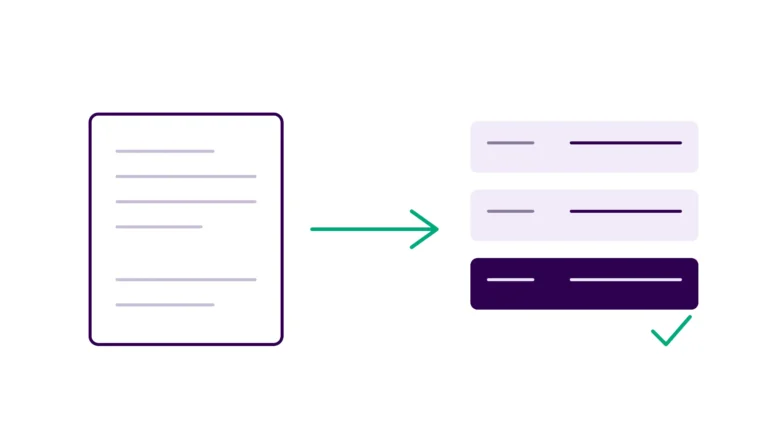
Set side by side, the two columns make the signature legible at a glance — which is the whole point of putting the three numbers on one page instead of leaving them scattered across three sections of the board pack. The left column is what the management accounts of a company compounding margin look like; the right column is what the accumulating cost of unaddressed manual work looks like once it is large enough to bend the P&L.
From financial signature to operational fix
The three numbers tell you the Manual Wall is present; finding where it lives is a separate exercise from reading the P&L. The aggregate signature has to be traced back to the specific processes producing it, and that means going below the financials to the work itself. A Profit Leak Diagnostic does exactly that: it walks each department’s recurring manual processes, attaches a loaded annual payroll cost to every one, and ranks them by what they consume. The Manual Wall Calculator is built to produce that costing on the highest-volume processes.
From the ranked list, the 0.5 FTE gatekeeper rule decides what earns a fix — no automation gets built unless it will save at least half a full-time employee’s worth of effort a year — and the costliest processes become Quick Wins, delivered inside six weeks so the saving lands on the P&L in the same quarter the work begins. Starting from the three numbers is what lets the finance function open the conversation early, with evidence, before a single process has been formally mapped.
The numbers are already in the room
The three figures are almost certainly in your board pack already, sitting in different sections and rarely read as a set. Revenue per employee sits with the people metrics, while margin and the headcount trend each live in a separate report again. Put them on one page, across three years, and the question stops being why the margin won’t move and starts being which processes are holding it down.